


Back in February, Dee Dee Starks Brown posted an article on Facebook from the San Antonio Express-News noting that the first time Las Moras Springs went dry was in “mid-July” of 1964 (thanks Dee Dee!). So its been on my to-do list to dig up this article and see what else I could scare up.
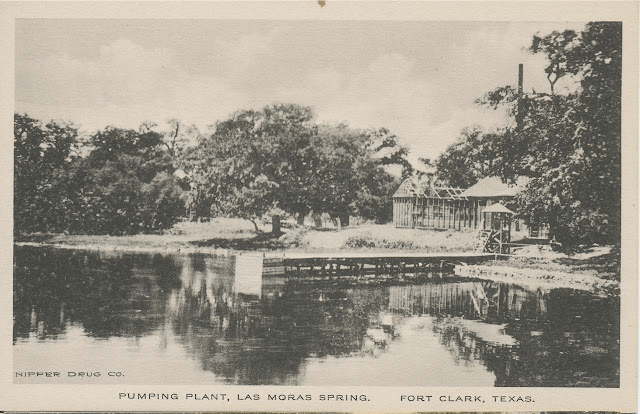
The first time on record the springs stopped flowing was on July 15, 1964 (SAEN 1964 a, b). The “record” extends back to 1895 but anecdotally extends back to at least 1852 when the U.S. military established Fort Clark (nee Riley) at the spring head. I couldn’t find when the springs started flowing again, but they were still dry by September 19, 1964 (SAEN 1964c). Given that the West Nueces, the primary source of recharge to the springs, roared with 42,500 cubic feet per second the very next day, the springs surely returned shortly thereafter. Interestingly, before the West Nueces roared on the 20th, there had been no flow in the river for 1,115 days!
The Edwards Underground Water District cited the development of irrigation production “northwest and particularly southwest of Brackettville” as the cause for the springs failing (SAEN 1964a; the words in quotes are from the District). Beneath an alarming photograph of a conehead with a catfish (see below), the District seemingly revised this to “northwest” of Brackettville (SAEN 1964e). The Austin American-Statesman wrote that, according to the U.S. Geological Survey, “irrigation wells may have, in part, drained the water down to the no-flow level” (AAS 1964; the words in quotes are the Statesmans’). I haven’t located the source documents that informed the first San Antonio Express-News article and the Austin American-Statesman article.

In response to the springs failing, Brackettville drilled an emergency well (SAEN 1964d). In other words, the springs failed before the city had a well. For the week or so it took for that well to come in, the Texas Highway Department hauled water to Brackettville from a nearby well on the Frank Zinsmeister Ranch (SAEN 1964d). Before the springs dried up, the city pulled water straight from the spring system.
Not everyone was happy about the well. A few months later, about “80 housewives assailed City Hall … to complain of rust-stained sheets and clothes” (SAEN 1964c).
The springs have gone dry several times since. I’m not quite clear how many just yet since we are still in the process of getting the data from the International Boundary Water Commission (who’s telling us they never collected data at the springs…) and the U.S. Geological Survey, although we have some data from the latter. Check back later for an update!
Ashworth and Stein (2005) presented a plot that suggests the springs went dry in 1969, 1971, 1980, and 1996; however, a clandestinely acquired data set suggests that, although the flows were low-low-low (generally less than 1 cubic feet per second), the springs only zeroed-out in 1966 (which is curiously before the data in the graph below). These inconsistencies in data are why scientists are anal retentive on accessing the original data source rather than receiving them from secondary sources or third parties. It’s also unclear to us at this point if the monthly measurements are spot measurements (measured at a specific time) or monthly averages. It’s probably the latter, but we need to know since that little tidbit of information says something about how good this data is in representing when the springs go dry.

My clandestinely acquired data shows that the U.S. Geological Survey started collecting daily flows in October of 2003. Ashworth and Stein (2005) also show that the Survey started collecting data in late 2003. But for some reason, the Survey only provides data on their online data server for the springs starting in October 2014 (and, yes, we checked the legacy site as well; the Survey is seeking to “upgrade” to a new system that shockingly doesn’t provide all the historical information).
The clandestine data shows that the springs went dry for four days in May 2013. The official Survey data shows the springs failing to flow in 2022 for 85 days, 2023 for 111 days, and 2024 for 118 days as of today.

Information on when the springs went dry is important for understanding why the springs went dry. For example, we can compare different droughts to when times when the springs failed to see if the springs are failing during droughts they survived in the past and then look around for what might be different.
REFERENCES
Ashworth, J.B., and Stein, W.G., 2005, Springs of Kinney and Val Verde County: report by LBG-Guyton Associates for the Plateau Regional Water Planning Group, 38 p, http://ugra.org/assets/pdfs/SpringsKinneyValVerde2005.pdf
SAEN (San Antonio Express News), 1964a, Irrigation blamed for drop in flow of famous springs: July 17, 1964, p 48.
SAEN (San Antonio Express News), 1964b, Brackettville wets its lawns again as well produces: July 19, 1964, p 11.
SAEN (San Antonio Express News), 1964c, Area city finds rust in water: September 19, 1964, p 44.
SAEN (San Antonio Express News), 1964d, Thoughts of Brackettville people center on water: September 19, 1964, p 48.
SAEN (San Antonio Express News), 1964e, Startling water level drop listed: September 4, 1964, p 21.
 so secret, occult, and concealed
Oh boy! Thanks! A link to this is going in the Substack. And on the Brackett Voice.
Um. Clandestinely acquired data set? Are you just not telling anybody? I have this vision of you in a trenchcoat and fedora, on a darkened Ann Street in Brackettville, walking toward a similarly-clad fellow who, as you pass one another, surreptitiously hands you a folded sheet of paper with the flow rates written in code.
I find it interesting that Plateau report says the MAG for the Edwards Trinity in Kinney County is 22,432 af a year. I think the current MAG here is 70,000 af. I presume that’s all the various Edwards aquifers but I’ll have to look it up. I can’t keep this stuff straight without referencing and re-referencing.
Again, thanks for your work. It’s really invaluable.
Carolea
LikeLike
Ha! “clandestine” = I got it from someone that I don’t know wants to be named.
I didn’t take a look at the MAGs in the reports (a future post…), but you are right in that there are different MAGs for the different flavors of Edwards in the county. I also plan to do a post on those flavors.
Thank you for your comments!
LikeLike