

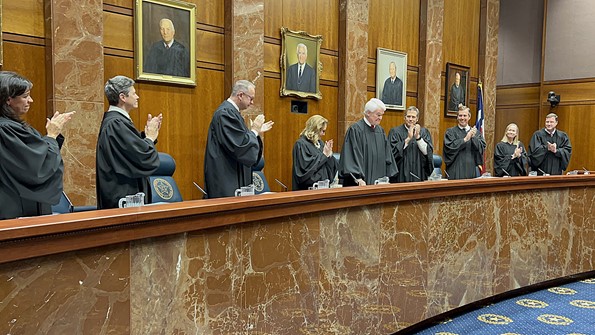
In Texas, we elect our state supreme court justices. Seems dangerous in this wacky world of ours (couldn’t a non-attorney be elected as justice?), but the system seems to have worked thus far. In 1988, Texas voters elected Nathan Hecht as a new justice of the Supreme Court of Texas, and he has served as a justice since (and as the chief justice since 2013) until his (mandatory) retirement on December 31, 2024. He is the longest serving member in the history of the Texas Supreme Court.
I first became aware of Judge Hecht on the Ozarka case in 1999 (Sipriano v. Great Spring Waters of America Inc). The Supreme Court of Texas shocked the Texas water world by taking an appeal after a landowner accused Great Spring Waters of draining a nearby well (hydrologically, this was highly unlikely, but that’s another story). On its surface, the Ozarka case was classic Rule of Capture where those allegedly impacted by someone’s pumping could go eat dirt. The Court had rejected similar appeals in the past. The District and Appeals courts had ruled for Great Spring Waters, so why did the supreme court take this case? Some speculated that the court was flirting with throwing out the Rule of Capture. Indeed, Sipriano asked for a change from the Rule of Capture to the Reasonable Use Doctrine.
Ultimately, the Court ruled for Great Spring Waters under the flowing banner of the Rule of Capture. Justice Enoch delivered the unanimous opinion concurring with the lower courts, but Hecht was moved to file a concurring opinion. His concurring opinion was notable (imho) because the Court sent a message that they might-could, at some point in the future, change the Rule of Capture. For example, Hecht wrote that “Because we conclude that the sweeping change to Texas’s groundwater law Sipriano urges this Court to make is not appropriate at this time, we affirm the court of appeals’ judgment” (emphasis mine).
Hecht went on to take the lead on a number of water decisions, perhaps most notably Edwards Aquifer Authority v. Day and McDaniel in 2012, which the Texas Water Journal termed the most important water decision in a generation.
Here’s to hoping he gets to work on his golf game!

 so secret, occult, and concealed